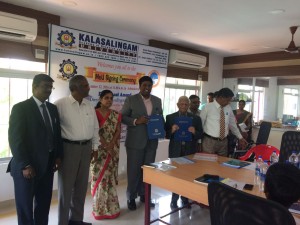
Karna Vidya Foundation signed Memorandum of Understanding (MoU) with Kalasalingam University to initiate the Training cum Placement centre for the Visually Impaired for the Southern parts of Tamil Nadu on 12th December 2016
Washington: A South Korean startup has developed an affordable Braille smartwatch which allows the visually impaired to receive and read text messages in real time and even read e-books.
The wearable, named Dot, relays the time with a set of pins that rise and fall. Users will be able to receive and read text messages in real time, read e-books and even learn Braille.
When it comes to watches for the visually impaired, there are not many devices that use real-time Braille text and the ones that do typically cost thousands of dollars.
Dot, its creators claim, is the first affordable smartwatch for the visually challenged that uses haptic technology.
Twenty four active pins on its surface, spread across four cells, allow it to display four Braille characters at a time. The smartwatch lets users read information in real-time by linking to any of their Bluetooth-enabled devices.
For instance, when a user receives a text message on their mobile phone, an app translates it into Braille and sends it to the smartwatch via Bluetooth, 'Gizmag' reported.
Dot's internal vibrator motor alerts the user to the message or notification and the display automatically shifts from telling time to displaying the notification.
Pins corresponding to the pattern protrude from Dot's surface, allowing users to read the information with their fingertips. Their reading speed is customisable.
"You can adjust the speed of the Braille output through the dials on the side of the watch," said Daniel Koh, Head of Media Relations at Fingerson.
"With four cells, there's a limit to the number of words being displayed at a time. However, unlike modern refreshable braille displays, which read one line at a time, the 'active braille display' is utilised to make braille automatically pass by in the user's hand as if it were an escalator," Koh said.
Since reading long paragraphs on a four-cell Braille device might get tedious, the company plans to create a Braille Pad next that is more suited to reading e-books.
The company plans to launch the device in the US initially for a price below USD 300.
Source :
http://zeenews.india.com
Bracelet to help blind people navigate in the worksHowever now two entrepreneurial engineers from the Tec de Monterrey institute in Mexico have taken wearable technology beyond just emails and social networking, by creating a bracelet with a very specific purpose, to help the visually impaired navigate more safely the world around them.
However now two entrepreneurial engineers from the Tec de Monterrey institute in Mexico have taken wearable technology beyond just emails and social networking, by creating a bracelet with a very specific purpose, to help the visually impaired navigate more safely the world around them.
Based on an echo system, as used by animals such as bats and dolphins, the Sunu band bracelet emits high-frequency sound waves that bounce after hitting an object, before recording these waves with a proximity sensor and calculating the distance. The bracelet then sends this information to the wearer using vibrations, which increase in frequency the closer the wearer gets to the object.
The bracelet can be used both in and outdoors and has a range of 4.5 meters.
The entrepreneurs behind the design, Marco Antonio Trujillo Tejeda and Cuauhtli Padilla Arias, have also developed a tag to go with the bracelet that locates lost objects.
Place the tag on an object such as keys, and the tag will communicate the location of the object to user via Bluetooth, sending the information to the bracelet or a smartphone, using vibrations which will indicate to the user the distance of the object.
The bracelet is currently protected by international patent and is in the process of being internationally produced in Mexico. It will go on pre-sale through a crowdfunding campaign on indiegogo.com starting this month.
- More industry innovations to aid the visually impaired -
Also available to assist the visually impaired with mobility is the BuzzClip.
A small, discreet device that clips onto your clothing, the BuzzClip uses ultrasound to detect the objects around wearer, alerting them to potential obstacles with vibrations. The wearer can select the range, either 1 or 2 meters, and as one gets closer to the objects, the frequency and intensity of the vibrations increase. Users can also wear more than one BuzzClip at a time, to receive even more information about their surroundings, and protect all sides of the body from possible collisions.
Originally thought up in August 2014, BuzzClick, based out of Canada, is now available for pre-order on indiegogo.com, and is due to go into production in February 2016 for March-April deliveries.
Other wearable technology currently in development for the visually impaired is the Dot watch, the first braille smart watch. Compatible with both iOS and Android devices, the design coming out of South Korea allows the blind and those with poor vision to check not only the time, but also messages and tweets when connected to a mobile device.
Available to pre-order now and aiming to be on sale in the US, UK, and Korea between April and June 2016, with other English-speaking countries following soon after, it will retail at $300.
Equipped with 20-seat computer classroom, the Centre trains students from weaker sections, to enhance their education.
“Karna Vidya means learning through hearing. Visually challenged students have enormous capacity to learn and gather information through their keen hearing capabilities,” said G. Balasubrahmanyan, former president, RCMC.
The assistive technologies makes information accessible to them. “The Centre, which began in May this year, uses screen magnifier for partially visually-impaired and conversion of information in to accessible format through Digital Access Information System,” he added.
It also has a Scanning and Reading Appliance Camera Edition, which is a next-generation self-contained scanning and reading appliance for the blind and those with low vision.
“At present, we are offering two four-month courses – Computer Application with Screen Readers, and Soft Skills Development. The Centre trains the students to get employed in IT companies and IT Enabled Services as soft-skills trainer and technical trainer. We are planning to introduce courses for Post-Graduate and Doctorate students and professional and business courses such as Law and Information Technology,” said K. Raghuraman, Co-ordinator, KVTC, and Professor, Department of English, Government Arts College for Men, Nandanam.
A Talking ATM is a type of automated teller machine (ATM) that provides audible instructions so that persons who cannot read an ATM screen can independently use the machine. The world’s first talking ATM for the blind was an NCR machine unveiled by the Royal Bank of Canada on October 22, 1997 at a bank branch on the corner of Bank Street and Queen Street in Ottawa, Ontario.
Talking ATM in India: Union Bank of India became the first bank to make electronic banking easier for the visually impaired with its “talking” ATM. India’s first “talking” Automated Teller Machine has been inaugurated in Ahmedabad. The ATM by the UBI is the first of its kind for the visually challenged.
According to functionaries of the Blind People’s Association, the users have to plug-in a headphone into the ATM which has a unique voice interface and once it is done the machine guides them into further operations.
Admissions are opened for Competitifve Examinations Preparatory Course (CEPC) up to 1st August (Friday )2014 at KVTC
Registrations are invited from visually impaired friends for General Health Camp on 16th August (Saturday) 2014. The last date for registration is 10th August (Sunday) 2014.

